Monday, September 21, 2015

Haro, Spain, the Saint of Happiness, and a BIG Waste of Wine!

We picked up our rental car in Pamplona, said goodbye to Jeremy, our in-country host, and headed right back out of town toward Haro. We'll be returning to Pamplona for a few days at the end of our trip, so we just pushed on.


Today, Haro is a humble agricultural town in the middle of an ocean of vineyards. It's easy to see that once upon a time in it's history, Haro had enjoyed considerable prosperity. These days it was looking a little on the downside, but the working class core of the village had hung on. If you took away the shiney wine tour bus, it felt like we were visiting old Spain. There were the regular clots of old guys in the bars for coffee in the AM's and the same crew back again for tapas in the afternoon. The elder women could be seen going into the church in the morning and shopping in the afternoon. Everywhere people carried loaves of bread; cars were parked wherever and every direction; and small, round guys like me wearing black tams could be seen on bicycles.

In the very center of town was the Church of Santo Tomás, an imposing structure with intricate carvings in stone and on the doors. It had a very tall and ornate steeple. It's another demonstration of the wealth the town once possessed. As is the case with so many of these grand structures, it literally took generations of builders to finish just some part of the construction. I couldn't escape the sense the tower was like a giant push-pin anchoring the village in its place in the countryside.

We stayed about four blocks from the church in the center of the town at Hotel Los Agustinos, billed as an old monastery. In fact, the structure has had many incarnations prior to becoming a four star hotel. In 1373 it was a monastery for ten or so monks. Then in 1809 it was taken over as a military garrison. Two years later it served as a military hospital and then in 1839 it served as a prison. Finally, in 1989 it became a hotel and was clearly the best accommodations the town had to offer. We had two, absolutely four-star dinners in the hotel, and on the supporting columns next to the table were inscriptions carved into the stone from angry prisoners with a lot of time on their hands.

On our second day in Haro, we managed a two-fer. Wine tasting late AM and then what was supposed to be a two hour walk in the afternoon.

First the wine tasting...There were easily a dozen bodegas within walking distance of our hotel. We could have opted for the fancy wine bus, but it seemed silly when we could almost see our destination from the hotel. Max, being our wine guy, had done some research and we chose Bodega Muga and Bodega Alta. Alta is also what you get after about two hours of tasting wine. It was fun, slightly educational, and we all managed to purchase wine that we liked. Funny how the wine kept tasting better as the morning unfolded!

Haro is also the home of the biggest waste of wine imaginable. At the Haro Wine Festival every summer, they have wine drinking competitions and contests. I haven't had time to find out what those events are, but I do know about the Batalla de Vino (Battle of Wine). At one festival way back before anyone can remember, someone emptied his wine glass over his friend's head, and the rest is literally history. Today, the happy revelers run around pouring wine on each other from buckets or any container available. Over the course of the event, 130,000 liters of wine are thrown using all types of containers. The result is a large crowd of people looking very much like wine grapes themselves, only making considerable more noise.

We took our purchases back to the hotel and then headed out for a short nature walk. We had chosen the statue of San Felices as our destination, about six kilometers out of town on a little used road. We're thinking Felices from the song Feliz Navidad we've all heard and that paying our respects to the Saint of Happiness was generally a good idea. That's wine tasting in the morning working for you. We headed out on our walk and a little ways out of town discovered a Caminos Naturales and a segment of the Camino de Santiago. We left the highway for the more natural trail and became happy pilgrims.

The route was indeed natural in that it took the very long way around through the countryside to get to the base of a small mountain that had San Felices on the top. Two hours longer actually. We passed lots of grapes, an almond tree, fig trees, and old Roman ruins. By the time we tired walkers got to San Felices, we needed a dose of happy.

In the 6th century, San Felices and his disciple San Millán, actually built a hermitage on top of this mountain where I guess they spent their days in contemplation. Because it was a pilgrimage trail, some suffering was in order. The trail didn't end until twenty minutes later after a long climb of stairs to get to the Saint's feet. The vista was almost worth it.

San Max - Monastary
We took the road back, pretty much done with pilgrimages and nature for the day. Yes, we were tired, but when the waitress told us that San Felices had no connection to the word or feeling of happiness, and that he was just a Saint with a similar sounding name, it put the very long walk and it's trials in perspective. We had our second four star dinner in our hotel during which we decided we'd cut our Haro stay short and head for France the next morning.

More soon as we leave Rioja wine country and head for Max's place near Bordeaux in the morning.

Feliz Navidad to you all,

Earl, Gwen, and Max


Saturday, September 19, 2015

Torla to Jaca Rain Day

With storms predicted for our last day in the Ordesa and Monte Perdido National Park, we decided to not risk another hike. The truth was my feet, no, whole body was so tired that if the others decided to go, I was going to get stoned on café con leche in the hotel and just relax watching the weather. Wisely, we all voted not to risk a miserable, wet hike, and our spectacular trip host, Jeremy, quickly put together a tour of a few of the typical mountain villages we had been seeing from highway distance as we traveled.

Eventually, we wound up in Jaca, home of a still-solid, pentagon-shaped fortress called the Citadel, a fortification dating to the late 16th century and the only fortress in the world in this style of construction still standing. I'm thinking this is where the Pentagon in the US got the idea. There was a terribly bored herd of deer living in the moat of the fortress, a concept that didn't really make sense, especially to the deer.

We also toured an enormous 11th-century Romanesque cathedral containing the Diocesan Museum of Jaca. The museum is purported to contain the best collection of Romanesque and Gothic church art in Spain and maybe all of Europe. As it was explained to us, in each of the mountain village churches, the chapel had it's own art work visually explaining the Christian story to the mostly illiterate villagers. Because so many of these churches were being abandoned, monies were raised to carefully remove the artwork to this museum and and another in Madrid. In one case the museum actually built a replica of the whole chapel from which the artwork originated. We were only there ninety minutes before it closed and just got a sampling of these beautiful paintings, statues, old carvings of the Blessed Virgin, and other artifacts. It was, in fact, a really good Catholic history museum.

We took our tapas in the Jaca old town. The weather had rather suddenly turned sunny just in time for our meal. Jaca turned out to be another great stop and another of the many occasions to be grateful for our trip shepherd, Jeremy. If you're thinking about a trip to this part of the world, or maybe take on one of the Camino de Santiago routes, Jeremy offers supported trips, self-guided trips, and customized itinerary expeditions, like ours, all over Spain. For me, this week was like traveling with a country-literate pal who is excited to share his world with you. Check out his services at: IberianAdventures.com.

That evening, the predicted storm finally did hit, big time. It was great to experience such dramatic weather from the security of our hotel. We really felt sorry for those who chose to hike in the canyons that day, and all the happier for our great rest-day experience. We had our final celebration dinner that night in Torla, at an Asador or restaurant specializing in grilled food. Combined with local wine, it was the perfect end to a physical week, full of natural beauty, interesting cultural experiences, and flat out great people.

I'll plug in a couple of pictures at the end...

Tomorrow we're off on the 2.5 hour drive to Pamplona to get the rental car for our next leg of the trip into the heart of Rioja wine country. Sadly, we'll be saying goodbye to Jeremy who has made it all so easy.

The next post will tell the story of what Rioja wine country holds in store for us. Good chance there will be delicious wine and at least one hike near a vineyard.

Till then, blessings to all and vaya con Dios,

Earl, Gwen and Max


Thursday, September 17, 2015

The BIG hike in Torla

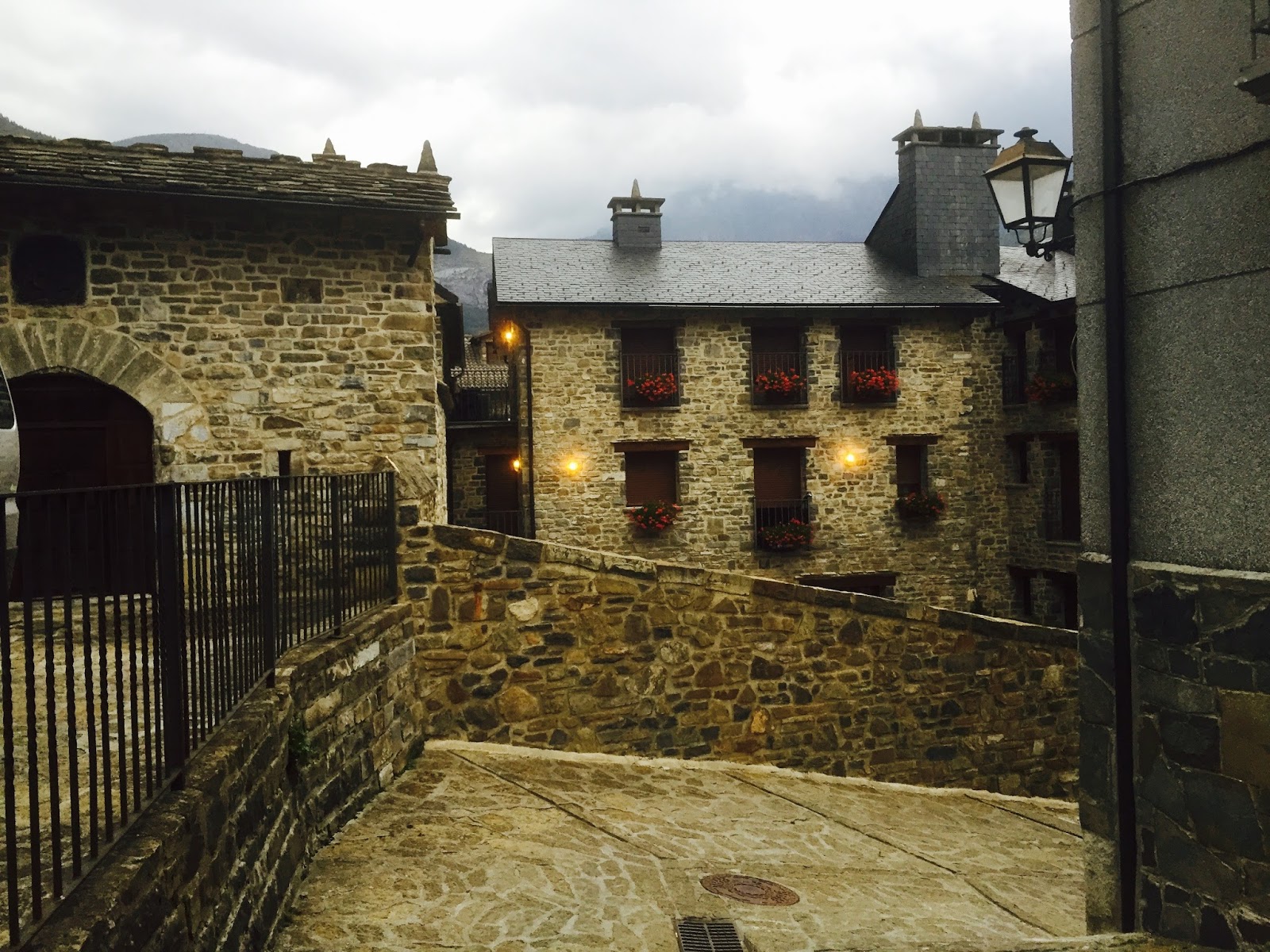
The biggest scenery yet greeted us in Torla. The hotel, a stone-built cousin of our first, was a little nicer. It sat just outside of town on the edge of Ordesa National Park. The town itself was a little older and presented an almost medieval personality when seen against the mountain backdrop. We had arrived between two storm fronts on a gray and misty day, which made the scene all the more dramatic.

After settling in, we met Fede, our mountain guide for this part of the trip. He was ready to go on the short, 2.5-hour warm-up walk up a valley near our hotel. I was still recovering from the previous day's climb and really needed to opt out. In truth, I was steeling myself for what was coming.

Fede
Fede was 32, looked 22, and was always dropping clues to his experience like, "yeah, I've climbed the Matterhorn a couple times," or "When I take clients mountaineering in the Alps, we . . . ." Our hikes were to be another literal walk in the park for him and a survival experience for me.

My afternoon was spent doing some laundry, a little writing, and taking a nap with the cool mountain breeze coming through the window. Heavenly! The brave hikers returned around seven, cold and tired. In this season, the national park buses were only running on the hour so they had to wait for forty-five minutes at the end of their hike. At five thousand feet, the air cools quickly after sundown, so they were both ready for a hot shower before dinner. The shower was about all they had time for as we headed out for dinner about 8:30 for the short walk to town.

It's a little romantic walking the streets of these old villages. It's not difficult to image the daily life of the residents hundreds of years ago. The stones hadn't changed much in centuries and took little note of who was walking on them.

We had a great dinner in the old town in a bar that was a cave hacked into the wall of the place and then bricked up. Our conversations were slightly amplified and it felt very cozy. The picture of us didn't come out that well, but we were indeed a merry band of adventurers and happy to be in that place with each other.

Because it was almost 9 PM when we finally ordered, we went light with a selection of about six different tapas to share. It's a great way to eat, with each one a tasty delight and often a treat for the eyes. Served with fresh baguette and a cold beer, it's my perfect meal.

Transportation to the trailhead was again by national park bus. The bus was packed with people, but when we arrived, most of the hikers avoided our route. I should have gotten the clue! Because Thursday was the only really sure weather day, we had decided to seize the moment and go for the BIG ONE. It would be a nine hour round trip, with a 2 hour, 2000' very vertical climb starting a short distance from the bus. Turns out it was really hard and well worth the effort.

Fede kept us moving Really Slow during the steep ascent. This flat out made it possible for me to do this leg at all. We were climbing from 5000' to 7000' after all. Other hikers passed us (sometimes with a huffy attitude) and, as Fede predicted, we passed them two-thirds of the way up as they sat exhausted on the sidelines. That was fun! After 2 hours, we arrived at the top of the climb, where there was a vista point that rewarded us for our efforts. The photo shows the view looking down to the valley floor. Yup, proud of myself!

From there it was an easier but long four hour ridge walk down to the valley floor. The big vistas followed us down the trail. It was a lovely place to take a lunch with the mountain peaks and hillside waterfalls spread out in front of us.


The end point of that leg of the hike was the Cola de Caballo or Horse Tail Falls. As we approached the waterfall, it seemed to grow in size and fan out across the rocks just as its name implied. It was also where we met up with 60 or so of the other hikers from the park busses who had taken a different route. After a brief rest, a change of socks, and some second skin on a hotspot or two, we set out on the final leg of the hike.

We followed the river, created by the falls, down the valley and passed waterfall after waterfall on the way. Each set of falls was spectacular in a different way. Given our fatigue and sore feet, it was a great form of entertainment as we eased down the valley. As we got closer to the end of the hike, people drained out of the hills on other trails from various directions, and we all wound up in a long line to catch the busses for the ride back to the village.

After this hike, you'd have think we'd have gone directly to the showers. Truly, I was ready. But the sense of relief with the big hike behind us, and the connection and gratitude for Fede gave rise to another celebratory beer with the whole group in the pub at the hotel. Lest you think we're a bit overdoing this beer tradition, you should know that the beer is a blond Pilsner, just a little tart, served in small glasses, and is the perfect cold beverage for weary hikers. It's a fine conclusion to a grand adventure. Another nice dinner in Torla and early to bed made for an all around great day.

At the end are some other hike photos that I couldn't fit in above. They make me happy and I hope you enjoy them too.

I'll finish the Torla story in the next post. The second weather front is about to set in, and decisions about the next hike have to be made in the morning. I went down hard dreaming of high mountain passes and roaring streams.

Soon . . .

Earl, Gwen, and Max


Monday, September 14, 2015

Hikes in Taüll and Life in Spain

We finally met up with our hiking pal, Max, (forgive the up-the-nose selfie), and after another Barcelona night, we grabbed the AVE bullet train to Lledia. For the record, the train was inexpensive, on time, and did 185 mph at the top speed. It was a smooth and quiet ride the whole way. Trains are just so, so, right, and every time I'm in Europe and use them, I'm a little angry and embarrassed to not have them in the US. Thanks for listening to my rant, I feel better now.

We were picked up at the train station in Lledia by Jeremy of Iberian Adventures, our host for the next six days. More on Jeremy later. Jeremy constructed a series of six hiking adventures out of two towns, Taüll and Torla, each near a different Spanish Pyrenees National Park along the northern border of Spain.

Because of the pace of hiking, resting (kind of) and then late night eating, I've been playing catch up on these posts . . . possibly as it should be. Pretty marginal WiFi in most places so far, too. So here's a taste of the high points from the first town.

Our first destination was a two-hour drive to the very small and old town of Taüll (pronounced Tah-ool), high up in the hills and near the first national park in the Vall de Boí. Yup, Valley of the Boy. It's a town made mostly of the local stone and built in the 800's. It's very much like the MANY similar towns that dot the Spanish countryside in this part of the world. Each town has narrow streets and a small church. And each is beautiful in it's own right.

Our hotel in Taüll was the El Rantiner, it looked like the other stone-constructed places in the village and high up in the valley just outside of town. Our room had an awesome valley view. To give you a sample of the age of these towns, the small church in the photo just below our hotel is over 1100 years old!

The Romanesque Church of St. Clement de Taüll is one of the reasons the town is historically significant. While the exact day it was built is unknown, the best local guess is somewhere around 900 AD. It took till the 12th century for the church to be consecrated. The church is part of the reason Taüll and the surrounding area is a Unesco World Heritage site.

It was a short national park bus ride from our hotel to the Aiguestortes I Estany de Sant Maurici National Park. Our host, Jeremy, being an all around great guy, with 15 years in the custom tour business, knew we would need time to adapt to the almost 5000' of altitude in the village. He was kind to have our first hike on arrival day be only an hour and a half and mostly downhill. There was nothing in Minnesota to gear me up for just about anything starting at or above that altitude. In fact, going up the stairs to our room was a breathy experience. The next day was a big wake-up call for me.

Before I tell you about the first BIG hike, you might find it interesting to learn about breakfast in these hotels. It's a similar drill in most of all the hotels and it parallels what you'd find in a freeway hotel in the US, only way better. It's really a grand buffet of breads and pastries (great croissants), yogurts (some homemade), fruits, melons, cheeses, a selection of dried ham, meats, and cheeses. There are always teas and the best ever coffee con leche or coffee and hot milk. I've yet to figure out how they keep the milk so hot without it getting that little film of yuck on it but it's always fresh tasting. That happened every day for six days. Now imagine facing all that and then going on a big hike! That also happened every day. Moan!


10 Points if you can
name this mushroom!
In each of the two national parks, Jeremy had arranged a local mountain guide with high mountain certifications and year round skills. I don't mean your average tour guide, even though these guys really knew everything about the landscape, flowers, and even the mushrooms. They could have also taken us to high altitudes, mountaineering, rock or ice climbing, canyoneering, or just about any dangerous mountain activity you could imagine, and do so in any season! Our first guide was Moises or Moses. I couldn't shake the feeling that they were seriously under-employed getting an out of breath elder guy and his younger and more in-shape pals up the mountain.

The most important thing I learned from them was how to walk! Seriously, how to take on hikes at more altitude than you're used to by taking REALLY small steps, NOT pushing off with your toes (to save calf muscles), and to have a very slow rhythm. It felt monastic walking that slowly, but because if it, I did have the energy to finish the hike.

The lake bottom center is pictured above!
We did two big hikes in Taüll after the warm up. The first one was about five hours to a high valley saddle above two beautiful mountain lakes. There were giant vistas on both sides, and cows with bells were everywhere, reminding us of the hikes we'd done with Max and our pals in Switzerland. The second was a seven hour hike to a peak above a different saddle. Really big hike with a grand vista. In spite of sore feet, legs, okay everything, it was so worth it.


Gwen being in generally better shape than me, and Max coming fresh from hiking in Switzerland, were both really patient with my struggle to breath. The guide also helped us all by keeping the pace slow and easy. Needless to say, I was dead tired each night. But it turns out the evening is when the real challenge began.

We'd always share an after-hike beer or two with some tapas to celebrate the hike and the fact that we came back at all. In those moments I briefly felt like a conquering hero. Being really tired from the mountain adventure, having a couple little tapas and cold beer with your hiking companions was a true balm for my tattered soul. But remember, this is late afternoon.

Awesome Tapas
Then the beer would meet up with the considerable fatigue from the  hike effort and the previous marginal nights sleep, and I'd have to drag myself back to the hotel. That would usually be about 5:30-6 PM. For reasons I could never understand, the rest of the crew were always somehow hungry at that time and ready for dinner! That meant I had about an hour to shower, collapse on the bed for a 30 minute nap, and then get dressed in time to head out for a walk through the village to eat. No I should say drag myself around the narrow streets of the village to eat again!

There's no use going out for dinner before 8 or 8:30 anywhere in Spain. Don't even ask because the answer is "What?" while cocking their head like a dog watching TV. It's just not going to happen. When you do sit to eat, the food is tasty, inexpensive, often grown locally, and served with nice local wines. The pace of dinning is comfortably slow. That means you go to bed at eleven, full of a big meal, try to sleep, and then start the whole cycle over with a big breakfast at 8 AM the next day! Getting the picture? Six days!

REALLY tired hikers!
I'll tell you about the hikes in Torla in the next post. I've got to clean up to go eat or sleep, or nap, or pack . . . I've lost track. But we are all having fun, and getting more fit every day.

Love from Earl, Gwen and Max!

Tuesday, September 8, 2015

Jet-lagging in Barcelona

(I'm running behind on posting owing to a great trip, BIG hikes, bad WiFi, and much needed napping. More about that in a later post. Here's how the trip got started.)

With breakfast, I just love cafe con leche, fresh croissants, and hearing five languages being spoken. The combination kinda perks me up. That's how the day starts here in our hotel in Barcelona. This is a 3-night stay to get over jet lag and to meet up with Max, our fellow adventurer, prior to heading off on Monday to the Spanish Pyrenees National Parks for the first leg of this trip.


During this visit, we did a lot of walking in the old Gothic and El Born districts, literally just above the ruins of the oldest part of Barcelona. More on that in a moment. We also did most of our exploring as far away as we could get from Las Ramblas (LR)! The LR is called Champs-Elysées of Spain. While it does have a weird beauty of its own, for me it's basically a crowded tourist trap this time of year, filled with hawkers selling bad food and expensive drinks. There are people pretending to be statues, and of course, pick pockets everywhere. I guess you could call that beautiful?

In the oldest part of the city, you can still see the large stones of the old Roman fortifications combined, many times over, with the stone work of later days and other cultures. But to really get to know Barcelona, you have to dig a little and actually remove a few layers of the city to reveal the Roman and pre-Roman history just below. Turns out in 1920 when they were digging up the city, they discovered what came to be 43,000 square feet of the Roman town of Barcino from the 1st century AD. It was an amazing peek into the life of the ancient city with streets, villas, commercial laundry, a dyeing shop, and storage vats for oil and wine all two stories down.

One of the stops on our groggy first day walkabout was the Barcelona History Museum. While you can research the place yourself, among many fascinating details I learned was in the street outside the dyeing factory there was a fountain like structure men could pee into and the pee was then funneled into the dye shop! The dye shop actually paid the city for the collected urine because it was one of the valuable and necessary ingredients for setting different colored dyes into fabric. Fragrance aside, I think there's a business model in there somewhere!

Walking away from Las Ramblas to the east, we wound our way through the wonderfully crooked and shady streets of the Gothic and El Born sections of the old city. About as far away from LR as we could get on foot we came across a chocolate museum. Or, more correctly stated, the "Museu de la Xocolata." Nothing like a cold and almost frozen chocolate beverage, something between (dark) Xocolata milk and a malt in consistency, to fortify us for the walk back to our hotel.

We didn't take in the museum because we already knew about the history of cacao and we felt the many sculptures made of Xocolata were basically a waste of a precious resource. We finished our beverage, bought some dark Xocolata with raspberry and headed back out.

For our second evening out, we headed back to the Born District for tapas. It used to be seaside accommodations for the rich in the middle ages, but today it is far enough away from the tourist crush to have kept some charm, calm and most importantly, its dignity. Born is really still a "neighborhood" where real people live, yet speckled with small tapas bars, a little shopping and quaint small parks. The pictures at this link will give you a sense for the serenity this part of town bestowed on us weary travelers.

So let's say the story of the adventure is launched in a jet-laggy kind of way. We're landed, getting our feet under us, and coping with entry into a very different world. We're coping with lots of people, traffic, hawkers, exhaust, and a whole society who think starting dinner at 9:30 is perfectly natural. Apparently they also think socializing till 3 AM, and for drunks to alternately singing for joy and rage at the world in anger till 4:30 AM, is kind of about right.

With any luck, the next post will be from a quiet little hotel high in the Spanish Pyrenees Mountains.

Love to all and Why not go?

Earl and Gwen