Showing posts with label Spain. Show all posts

Friday, September 25, 2015

Traveling from France to Llanes, Spain and Some Cultural Lessons Learned

The road trip to Llanes, Spain from France was surprisingly easy! Both France and Spain have the incredibly good sense to keep trucks off the freeways on Sunday. As a result, we cruised along at 120, passing truck stops full of parked trucks and feeling pretty good about our trip. That's just 120 kilometers per hour but it's fun to say 120!

When you're a tourist, you can't help but look at the country you're visiting through your own cultural lenses. So here are some of our "ah-has," just a few things we've discovered about the parts of both France and Spain we've visited so far:

Unlike the United States, just about everything is old. In these parts of Europe, there is layer after layer after layer of history, piled on top of each other. Each layer a history of invasion, a struggle for survival, or some form of domination by kings, popes, or dictators. It's an incredible collection of stories, each written in the bones of the ruins and communities that are around us everywhere in the countryside. We just don't have layered history that deep in the US, we're more like a pancake.

Stone is everywhere. Most of the structures from Roman times onward were built of the stone that is so much a part of both the Spanish and French landscape. Buildings, churches, cathedrals, corrals, fences, even cobblestone streets are all of stone. It's just part of the life here. It gives me a feeling of permanence or weight to all the history that had used these stones in so many creative and beautiful ways. Made my world in the US feel very young and temporary.

This is a very Catholic part of the world. Not that we've been looking, but we haven't even seen another religion represented. Just about every town has a church with a bell tower, A LOT of towns are named for a saint, and any hill of prominence has a church or shrine on the top. There may have been pagan or Roman temples on those hilltops prior, but the Catholic church has re-purposed most of them. The big churches are especially breathtaking given the shear physical effort it took in the era they were constructed. Especially lovely are the small churches in every village. These, too, speak to the long reach of the Catholic church.

Cars and roads are Really Small. Actually, they're about right for Gwen and I, but they look a little like the clown car at the circus when a big person or a family is trying the get out of one. The cars are small because when gas is $6-$7 a gallon, a small car makes sense. That and the fact that most of the driving we do off the major motorways is about the right size for two horses to pass. Don't even ask me about the parking! It's taken some time to pass even a small truck on the back roads without an internal scream. It's like being charged by a bull in the bull ring as they brush on by. I'm just getting over holding my breath with each one and just driving normally.

While I'm on the topic of roads, except for the motorways, there really have not been many straight roads. We are, in fact, driving as in steering our way through an endless onslaught of curves. It will be different in the bigger cities, but in the countryside and in small towns, they've simply paved over the old roads that wound around communities that were built for people, not cars. In the US, we got nuts about right angles and straight lines for roads. It's efficient, but really not anywhere as beautiful or interesting.

I also need to mention roundabouts. We've been in the rural parts of two countries for almost three weeks and we've seen maybe a dozen stop and go lights. It's been a complete pleasure to not have to stop to get through what we call an intersection. It's like being part of a swarm of fish all going downstream and you come to a rock and you all, simultaneously, just navigate around with inches to spare in every direction and nobody touching anyone else. You can even go around a couple times if you're lost, or just for the sheer joy of it!

We've also been reminded how people are really wonderful. We've been largely in rural towns and, in spite of sticking out like red cardinals in a flock of sparrows as tourists, the staff in the hotels, the waiters in the little cafes, and even people on the street have been helpful, friendly, and tolerant of my halting Spanish language skills. I have the problem that I'm just good enough to sound fluent in Spanish when I ask a question. It often brings a fast-paced and complicated response that leaves me shocked and as ignorant as I was before asking the question. In that moment I have to stop to try and translate while my helper is staring at me and confused by my silence. It's been fun.

On the way to Llanes, we had taken a little side trip to visit the Basque towns along the coast. I'm reading The Basque History of the World and have been learning about how these people have preserved their language and culture in the face of multiple attempted invasions over the centuries. Sadly for us, it was Sunday and everyone with a car had decided to get one more beach day in before the weather changed toward autumn. There were little cars jammed in to every available space near a beach for miles. We just kept diving. As the road signs testify, the Basque language is almost undecipherable to an outsider, and another powerful statement about their intention to remain independent.

Gwen's Sketch of El Habana
We arrived at El Habana near Llanes after a six hour drive and celebrated with a wonderful arrival meal. El Habana happens to have a great restaurant and we were so done with driving. We're actually not in the town of Llanes, but on the opposite side of the freeway and in the country. We really lucked out on this choice. At night all we can hear is the wind in the trees and the bells on the stock in distant pastures. Here, cows, sheep, goats, and even horses have bells on them. In the countryside, you can always hear bells, it's the music of this part of the world.

On that tranquil note, I'll end this early. Tomorrow is a big hike day and rest is in order. Com'on back for the tale of the Picos De Europa National Park.

Blessings,

Earl and Gwen

Tuesday, September 22, 2015

Off to Biarritz, Bergerac, Saint-Émilion and Life in the French Countryside


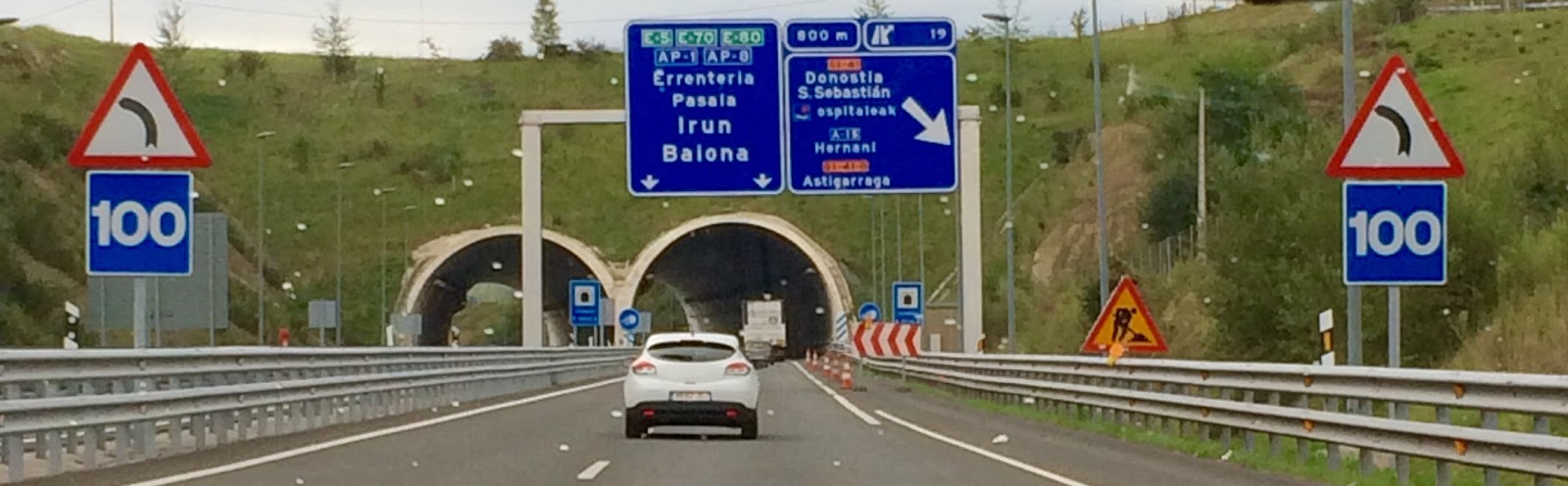
After our standard pub breakfast of coffee, croissants, and fresh squeezed orange juice, we packed the car and departed Haro. It was a five hour drive to Max's place in France and our first real encounter with the Spanish and French freeway systems. Spain is drunk on signage. For example, there would be a sign IN FRONT of a tunnel telling you that you were about to enter a tunnel. Approaching an exit, you'd have four or five signs in a row each with different numbers and names for basically the same road. There are even blank signs where they hadn't yet figured out what to say but someone must have had the feeling there should be a sign about there. In France it is the opposite. You almost can't find a sign when you need one. Day and night difference.

To break up the road trip, we took a detour into Biarritz, France. It's purported to be a playground of the international rich and famous along with a pack of surfing dudes. Of course, we added to the zoo, but we didn't bring as much color.

We ate on the boardwalk in front of the white building.

It was indeed a beautiful place and we had an appropriate ocean side lunch each with something fishy. It was odd to be so directly looked at by everyone. I think they were scanning us for labels and status markers so they could instantly categorize and put us in our right place. It's the only time I've wanted an ACE Hardware shirt. I mostly loved looking at the ocean.


Arrival at the Studer house was like falling into a cozy 5-star accommodation all packed into a quaint French farmhouse. Beautiful, perfectly appointed, unassuming, and surrounded for miles (literally) in every direction by soon-to-be-picked grape vines.
If you add to it the most gracious hosting skills of Max's wife Margaret, the playful energy of their dog Molly and new puppy Bimala (Bee), we were well set up for a needed respite from our first 10 days of travel. And all took place in a postcard stetting.

After a rest day, the Studers took us off to the Wednesday farmer's market in the nearby town of Bergerac. It is, in fact, the home stomping grounds of Cyrano de Bergerac and his relatives. His statue adorns a central square and is surrounded by some very well preserved medieval streets and houses from the early 1600's. Just for a moment, it felt like I should be in tights, with leather knee-high boots, a blousey shirt, and a big hat with a feather in it. Brief though it was I enjoyed the idea.

A day later, Max, drove Gwen and myself on a road trip passing through endless fields of grape vines, literally visible to the horizon on the way to Saint-Émilion. The town is another UNESCO World Heritage Site, with Romanesque churches and shops and restaurants all along steep and narrow cobblestone streets. It is easily the most beautiful and well-restored old town we've seen this trip.

In this part of the world, when we say old, it means things like the Romans planting vineyards in the area as early as the 2nd century. I mean that's old. The town is named after a travelling confessor monk named Émilion, who settled in a hermitage cave carved into a rock somewhere near Saint-Émilion in the 8th century. That's what hearing too many confessions will do to a guy. Émilion planted a few vines, but it was the monks who came after him that really started producing wine on a commercial level. So it's no wonder the town is all about wine, with shops everywhere offering a range of mostly local wines from the affordable to terribly expensive varieties.

Can you read these prices?!
We had a standard, mid-afternoon meal of cured meats, local cheeses, salad, and, of course, a glass of one of the very affordable red wines in the area. While you can pay thousands of Euros for a bottle in this town, it's easy to get a really wholly adequate bottle with Saint-Émilion on the label for 8 to 10 Euros. Staying awake for the drive home after a lunch with a glass or two is a more difficult matter.

Trail between house and river
The next day Max took us on a hike from Port Sainte Foy et Ponchapt on the La Dordogne river back to their house. The "walk" followed the Camino De Santiago in reverse. There's a story in there somewhere about getting farther away from what counts, but I'll let that go. As we walked along the river, Max described how, during WW II, the opposite bank marked the border where German troops occupied the area. I just can't imagine life on either side of the river under those conditions.

The hike climbed out of the river valley to a summit that was home to what's left of an old windmill. In the photo, Max and Gwen are taking in the view. There are only a few around these days but this one had a 280 degree panorama of the countryside. It was a great rest stop.

The remaining 2 hours back was literally walking through vineyard after vineyard. We'd taste the grapes along the way, imagining the promise they held for the bottle. That old monk Émilion couldn't have imagined what he was kicking off when he planted a few vines outside his cave.

We had wonderful, chatty breakfasts and dinners each day with the people staying with the Studers. Margaret has what I've learned is called a "piano" arrangement for a cooking area and puts it to great use. Because of her love of cooking and considerable creativity, that ole piano kept cranking out wondrous creations. Soups, breads, roasted chicken, fresh garden veggies, breakfast porridge, jams, and great coffees. It was all served in an artful way and with Max's wine parings in support (well not breakfast). As I said to the Studers on departure, rather than being guests in the home of dear friends, it felt more like coming home to family. That's just how they do it.

Fully rested, nourished in so many ways, and with freshly laundered clothes, we bid our dear friends a somewhat sad adieu, and departed for our week near the ocean at Llanes back in Spain. The story of the road trip, Llanes, and the Picos de Europa National Park will be in the next post.

Below are some photos I didn't have room for.

Thanks for hitchhiking along, more soon,

Love from Earl and Gwen

Margaret Bergerac Tour
Max Bergerac Tour

Vineyard Flowers Before Storm
Studer home with Grapes

Winner Cafe Con Leche
Fish Salad

Gwen Market Day
Old Bergerac

Pisswah!

Monday, September 14, 2015

Hikes in Taüll and Life in Spain

We finally met up with our hiking pal, Max, (forgive the up-the-nose selfie), and after another Barcelona night, we grabbed the AVE bullet train to Lledia. For the record, the train was inexpensive, on time, and did 185 mph at the top speed. It was a smooth and quiet ride the whole way. Trains are just so, so, right, and every time I'm in Europe and use them, I'm a little angry and embarrassed to not have them in the US. Thanks for listening to my rant, I feel better now.

We were picked up at the train station in Lledia by Jeremy of Iberian Adventures, our host for the next six days. More on Jeremy later. Jeremy constructed a series of six hiking adventures out of two towns, Taüll and Torla, each near a different Spanish Pyrenees National Park along the northern border of Spain.

Because of the pace of hiking, resting (kind of) and then late night eating, I've been playing catch up on these posts . . . possibly as it should be. Pretty marginal WiFi in most places so far, too. So here's a taste of the high points from the first town.

Our first destination was a two-hour drive to the very small and old town of Taüll (pronounced Tah-ool), high up in the hills and near the first national park in the Vall de Boí. Yup, Valley of the Boy. It's a town made mostly of the local stone and built in the 800's. It's very much like the MANY similar towns that dot the Spanish countryside in this part of the world. Each town has narrow streets and a small church. And each is beautiful in it's own right.

Our hotel in Taüll was the El Rantiner, it looked like the other stone-constructed places in the village and high up in the valley just outside of town. Our room had an awesome valley view. To give you a sample of the age of these towns, the small church in the photo just below our hotel is over 1100 years old!

The Romanesque Church of St. Clement de Taüll is one of the reasons the town is historically significant. While the exact day it was built is unknown, the best local guess is somewhere around 900 AD. It took till the 12th century for the church to be consecrated. The church is part of the reason Taüll and the surrounding area is a Unesco World Heritage site.

It was a short national park bus ride from our hotel to the Aiguestortes I Estany de Sant Maurici National Park. Our host, Jeremy, being an all around great guy, with 15 years in the custom tour business, knew we would need time to adapt to the almost 5000' of altitude in the village. He was kind to have our first hike on arrival day be only an hour and a half and mostly downhill. There was nothing in Minnesota to gear me up for just about anything starting at or above that altitude. In fact, going up the stairs to our room was a breathy experience. The next day was a big wake-up call for me.

Before I tell you about the first BIG hike, you might find it interesting to learn about breakfast in these hotels. It's a similar drill in most of all the hotels and it parallels what you'd find in a freeway hotel in the US, only way better. It's really a grand buffet of breads and pastries (great croissants), yogurts (some homemade), fruits, melons, cheeses, a selection of dried ham, meats, and cheeses. There are always teas and the best ever coffee con leche or coffee and hot milk. I've yet to figure out how they keep the milk so hot without it getting that little film of yuck on it but it's always fresh tasting. That happened every day for six days. Now imagine facing all that and then going on a big hike! That also happened every day. Moan!


10 Points if you can
name this mushroom!
In each of the two national parks, Jeremy had arranged a local mountain guide with high mountain certifications and year round skills. I don't mean your average tour guide, even though these guys really knew everything about the landscape, flowers, and even the mushrooms. They could have also taken us to high altitudes, mountaineering, rock or ice climbing, canyoneering, or just about any dangerous mountain activity you could imagine, and do so in any season! Our first guide was Moises or Moses. I couldn't shake the feeling that they were seriously under-employed getting an out of breath elder guy and his younger and more in-shape pals up the mountain.

The most important thing I learned from them was how to walk! Seriously, how to take on hikes at more altitude than you're used to by taking REALLY small steps, NOT pushing off with your toes (to save calf muscles), and to have a very slow rhythm. It felt monastic walking that slowly, but because if it, I did have the energy to finish the hike.

The lake bottom center is pictured above!
We did two big hikes in Taüll after the warm up. The first one was about five hours to a high valley saddle above two beautiful mountain lakes. There were giant vistas on both sides, and cows with bells were everywhere, reminding us of the hikes we'd done with Max and our pals in Switzerland. The second was a seven hour hike to a peak above a different saddle. Really big hike with a grand vista. In spite of sore feet, legs, okay everything, it was so worth it.


Gwen being in generally better shape than me, and Max coming fresh from hiking in Switzerland, were both really patient with my struggle to breath. The guide also helped us all by keeping the pace slow and easy. Needless to say, I was dead tired each night. But it turns out the evening is when the real challenge began.

We'd always share an after-hike beer or two with some tapas to celebrate the hike and the fact that we came back at all. In those moments I briefly felt like a conquering hero. Being really tired from the mountain adventure, having a couple little tapas and cold beer with your hiking companions was a true balm for my tattered soul. But remember, this is late afternoon.

Awesome Tapas
Then the beer would meet up with the considerable fatigue from the  hike effort and the previous marginal nights sleep, and I'd have to drag myself back to the hotel. That would usually be about 5:30-6 PM. For reasons I could never understand, the rest of the crew were always somehow hungry at that time and ready for dinner! That meant I had about an hour to shower, collapse on the bed for a 30 minute nap, and then get dressed in time to head out for a walk through the village to eat. No I should say drag myself around the narrow streets of the village to eat again!

There's no use going out for dinner before 8 or 8:30 anywhere in Spain. Don't even ask because the answer is "What?" while cocking their head like a dog watching TV. It's just not going to happen. When you do sit to eat, the food is tasty, inexpensive, often grown locally, and served with nice local wines. The pace of dinning is comfortably slow. That means you go to bed at eleven, full of a big meal, try to sleep, and then start the whole cycle over with a big breakfast at 8 AM the next day! Getting the picture? Six days!

REALLY tired hikers!
I'll tell you about the hikes in Torla in the next post. I've got to clean up to go eat or sleep, or nap, or pack . . . I've lost track. But we are all having fun, and getting more fit every day.

Love from Earl, Gwen and Max!