Showing posts with label Llanes. Show all posts

Monday, September 28, 2015

Bye to Llanes and Hello Pamplona

For our last day in Llanes, we went back to the ocean. The sun was shining and, again, we needed to give our feet a rest day. Our pal Jeremy from Iberian Adventures had suggested Torimbia beach just west of our previous ocean walk.

Getting there meant another tight drive through the little village of Niembro, which led to an uphill road, which lead to a broad, 180 degree ocean vista. But it got better. From the car park there was a straight (and short) path out to the best possible vista point and lunch spot. Here's a couple photos to give you a sense for not just Torimbia beach, but what the whole coastline is like in this part of Spain. Lots and lots of small beaches, the vast majority with no food or bathroom services. Most surprisingly, there are no houses or vacation homes on the majority of them. Just miles of unspoiled beaches.


Views to the east and west from the vista point.


We spent the afternoon and evening back at El Habana. For our final dinner, we took a risk on a local specialty, Paella Negra or Black Paella. It's a rice dish with vegetables, chunks of fish, all cooked with sweet paprika, olive oil, seafood broth and the magic ingredient, squid ink. Ever the tourists, we both had flan to end the meal. They just understand that dish here, or maybe it's just more tasty because I'm eating it in Spain.


We packed up, said goodbye to the really nice folks at El Habana and headed off for Pamplona four hours away. I may have said it before, but the highways where we've been have all been great. People know how to drive, use signals, and stay to the right if not passing. It's been really easy going and I'd drive again in Spain if the occasion arose.

The terrain changed a lot on our short trip. In the beginning, we were traveling along the ocean and it was like US 1 along the California coast. From there we turned inland into the mountains and, with all the pines, it was a little like Colorado. As we got closer to Pamplona, it started to look more flat and open like Kansas. Or maybe I'm just a little homesick. The only goat we saw was one made of stainless steel in the middle of a roundabout. I guess that was the indicator we were headed for city life.


Finding our hotel in the middle of the old town was another one of those driving around roundabouts multiple times, looking for clues, and driving down what look like alleys, until a fancy hotel somehow appears in front of you. Ours is the Palacio Guendulain and it was a re-purposed home of the Count of Guendulain. The Count is apparently still kicking and living in Madrid. The Palacio is a 25 room hotel, still filled with family photos, antiques, and a collection of carriages in it's courtyard. I think Gwen booked it for it's location and quality and not the fact that it resembled her name. Imaging Gwen's Palace! Nice to be in this old part of the city and to be in relative comfort.
The Elegant the Palacio Guendulain!

That night we headed for the center of the old town, Plaza Del Castillo. It's the heart of the old city and it was packed. We were in a crazy kind of shock as we went looking for a place to eat. First, we were used to the quiet of small town Spain. Even Llanes was tame compared to this place. Secondly, having lost track of time, we forgot it was Saturday night. The place had all the excitement of the Minnesota State Fair with an emphasis on baby carriages and people drinking. I guess those behaviors do go together somehow.

We found a table on the edge of the chaos and proceeded to take in the Vida Espanol, city style. People walking around the giant square, kids running everywhere, different groups of men in costume singing in the corners, clowns, fire crackers, balloons full of gas, and a beautiful sunset over it all. Perfect spot for dinner in Pamplona. Here's a picture of Hemingway in 1959 having dinner in the same place. He spent a considerable amount of time in the area during the Spanish Civil War and was a big fan of the San Fermín Festival (Running of the Bulls) here each year. The crush of people around Hemingway is about what it felt like to us that night, except no one was paying attention to us.

We tumbled into bed after a big travel day listening to people singing and cheering about gawd knows what into the wee hours in the little plaza outside our hotel. Figured this would be good training for our two nights in the big time when we hit Madrid. More tomorrow for our last night in Pamplona.

In the home stretch,

Love from,

Earl and Gwen

Sunday, September 27, 2015

The Llanes Coast, Camino Secrets, Bocadillos, the Woman's "Newspaper," and the Sweet Shop


Today we ventured to the ocean on the west side of Llanes and hiked the Senda Costera - this is a coastal path running along much of the Asturian coast. Asturias is the province or region where we're staying. In the map above, Asturias is about the middle-top in pink and Llanes is on the right side of Asturias above the A5 number. Gwen says Asturias is a mauve color on the map and I can't even see the A5 number.

The walk along the coast is also another route for Camino de Santiago. There are at least eight major Caminos, and probably many lesser routes. The Camino in this part of the country is know as the Northern Route or the Coastal Way. It, too, is marked all along the way by the Camino scallop shell, even when the trail winds through villages and on beach paths. Frankly, that sign is everywhere. Well, everywhere we've been this trip in Spain and France. I guess as long as you go on a journey to get to the shrine of St. James in Santiago de Comostela, it doesn't matter what path you take to get there!

If you're thinking of doing a Camino, here's a great website that shares the good, the okay, and the really ugly parts of the journey by just about every route. It's title is 10 Reasons Why El Camino Santiago Sucks!

In addition to the hiking pilgrims, we were passed by a couple guys biking the Camino. So much for a prayerful walk. Actually, biking sounds like it would be a good idea. Most of the pilgrims we see look way overloaded with gear, tired, and lost in spite of the good directions.

We passed a few pilgrims hiking with big packs and carrying water bottles and bocadillos or bocata. In Spain, this is a sandwich made with what looks like baguette bread cut lengthwise, with a very thin slice of ham and some not very interesting cheese. Of course, there are different varieties in different places, but that's the most common one sold to tourists. It's the Spanish version of subway only with much less everything but the bread. I think it's a commentary on life in Spain, but that's another topic. You can get miniature ones called Pinchos about 3" long.

We walked from Poo to Celorio, and, yes, I know it sounds odd. It's pronounced "Poh," not that other way. The coastline is very rugged with sandy hidden beaches every here and there. Sadly for us, it was high tide and we traded beach walking for big vistas and crashing waves on rock.

On the way back to our car from the picnic, we came across an old, old, laundry facility below the road almost hidden in the trees. We're talking the kind where the women gathered centuries ago and did their washing together in stream water because there was no running water in the houses. It was situated next to a spring that was still running who knows how many centuries later. This one in Poo had been rehabilitated and was in like-new condition. One fellow referred to it as the woman's newspaper. I guess the news of the village had to be produced somewhere so with room for a dozen washer-women, most all the news about life in the village pretty much got spread around here.

It was market day when we got back to Llanes. Market is like a traveling Target store with groceries. You can get most of what you'd need for life here in these markets. The vendors reminded me of the traveling covered wagons with pans hanging on the side. I did peek into one grocery store and saw a sight you don't see often in the US. A whole wall of ham (the legs) hanging there in the open. Just another reason to eat less ham.

Being 2 PM, everything closes down but the tapas joints. It's creepy how, within about 15 minutes of the hour, everyone is at home or in a pub chatting away over coffee or a beer. About 4 PM, the whole town clears out and people go home to eat again. That's why we can't eat dinner till 9 PM. They're all full from eating all afternoon.

We headed to Llanes port with a long entrance from the ocean to the mouth of a river. It's been a fisherman's safe haven for centuries. Strange thing about the town is that there is only one bridge across the inlet and it's one way traffic only. If you cross that bridge for shopping or dinner, it's a very long and circuitous way to get your car back to the other side. We learned that the hard way one night after a late dinner. The map of the medieval town basically looks like what's left after a lot of worms have crawled off a piece of paper.

Gwen needed a sweet after our small beer and pincho, so to practice her Spanish, we did a little dress rehearsal and she headed off the to Confiteria (sweets shop). She came back with a small bag of goodies and smiling. In some universal language, the woman in the shop told her she was too skinny and needed to eat more cookies. Not sure but I'll bet we'll be going back to that shop.

We had the sweet munchie in the harbor area and then headed out to scout seafood restaurants for a fish dinner the next night. That's IF tomorrow's hike doesn't kick our butts and we can find our way back into town at 8:30 for a 9 PM dinner. Imagine in the States, and you're opening your restaurant at say 4:30, finding a collection of Americans waiting at the door. That's why they think we're weird.

Tomorrow we're off to Fuente De and the cable car ride to the trail head. We're finally getting the hang of how to hike in these mountains. Just get transported up the steep part and then do the easy back half of the hike on the way down!

I'll tack on a couple additional photos at the end.

Blessings from the high road!

Earl and Gwen


Friday, September 25, 2015

Traveling from France to Llanes, Spain and Some Cultural Lessons Learned

The road trip to Llanes, Spain from France was surprisingly easy! Both France and Spain have the incredibly good sense to keep trucks off the freeways on Sunday. As a result, we cruised along at 120, passing truck stops full of parked trucks and feeling pretty good about our trip. That's just 120 kilometers per hour but it's fun to say 120!

When you're a tourist, you can't help but look at the country you're visiting through your own cultural lenses. So here are some of our "ah-has," just a few things we've discovered about the parts of both France and Spain we've visited so far:

Unlike the United States, just about everything is old. In these parts of Europe, there is layer after layer after layer of history, piled on top of each other. Each layer a history of invasion, a struggle for survival, or some form of domination by kings, popes, or dictators. It's an incredible collection of stories, each written in the bones of the ruins and communities that are around us everywhere in the countryside. We just don't have layered history that deep in the US, we're more like a pancake.

Stone is everywhere. Most of the structures from Roman times onward were built of the stone that is so much a part of both the Spanish and French landscape. Buildings, churches, cathedrals, corrals, fences, even cobblestone streets are all of stone. It's just part of the life here. It gives me a feeling of permanence or weight to all the history that had used these stones in so many creative and beautiful ways. Made my world in the US feel very young and temporary.

This is a very Catholic part of the world. Not that we've been looking, but we haven't even seen another religion represented. Just about every town has a church with a bell tower, A LOT of towns are named for a saint, and any hill of prominence has a church or shrine on the top. There may have been pagan or Roman temples on those hilltops prior, but the Catholic church has re-purposed most of them. The big churches are especially breathtaking given the shear physical effort it took in the era they were constructed. Especially lovely are the small churches in every village. These, too, speak to the long reach of the Catholic church.

Cars and roads are Really Small. Actually, they're about right for Gwen and I, but they look a little like the clown car at the circus when a big person or a family is trying the get out of one. The cars are small because when gas is $6-$7 a gallon, a small car makes sense. That and the fact that most of the driving we do off the major motorways is about the right size for two horses to pass. Don't even ask me about the parking! It's taken some time to pass even a small truck on the back roads without an internal scream. It's like being charged by a bull in the bull ring as they brush on by. I'm just getting over holding my breath with each one and just driving normally.

While I'm on the topic of roads, except for the motorways, there really have not been many straight roads. We are, in fact, driving as in steering our way through an endless onslaught of curves. It will be different in the bigger cities, but in the countryside and in small towns, they've simply paved over the old roads that wound around communities that were built for people, not cars. In the US, we got nuts about right angles and straight lines for roads. It's efficient, but really not anywhere as beautiful or interesting.

I also need to mention roundabouts. We've been in the rural parts of two countries for almost three weeks and we've seen maybe a dozen stop and go lights. It's been a complete pleasure to not have to stop to get through what we call an intersection. It's like being part of a swarm of fish all going downstream and you come to a rock and you all, simultaneously, just navigate around with inches to spare in every direction and nobody touching anyone else. You can even go around a couple times if you're lost, or just for the sheer joy of it!

We've also been reminded how people are really wonderful. We've been largely in rural towns and, in spite of sticking out like red cardinals in a flock of sparrows as tourists, the staff in the hotels, the waiters in the little cafes, and even people on the street have been helpful, friendly, and tolerant of my halting Spanish language skills. I have the problem that I'm just good enough to sound fluent in Spanish when I ask a question. It often brings a fast-paced and complicated response that leaves me shocked and as ignorant as I was before asking the question. In that moment I have to stop to try and translate while my helper is staring at me and confused by my silence. It's been fun.

On the way to Llanes, we had taken a little side trip to visit the Basque towns along the coast. I'm reading The Basque History of the World and have been learning about how these people have preserved their language and culture in the face of multiple attempted invasions over the centuries. Sadly for us, it was Sunday and everyone with a car had decided to get one more beach day in before the weather changed toward autumn. There were little cars jammed in to every available space near a beach for miles. We just kept diving. As the road signs testify, the Basque language is almost undecipherable to an outsider, and another powerful statement about their intention to remain independent.

Gwen's Sketch of El Habana
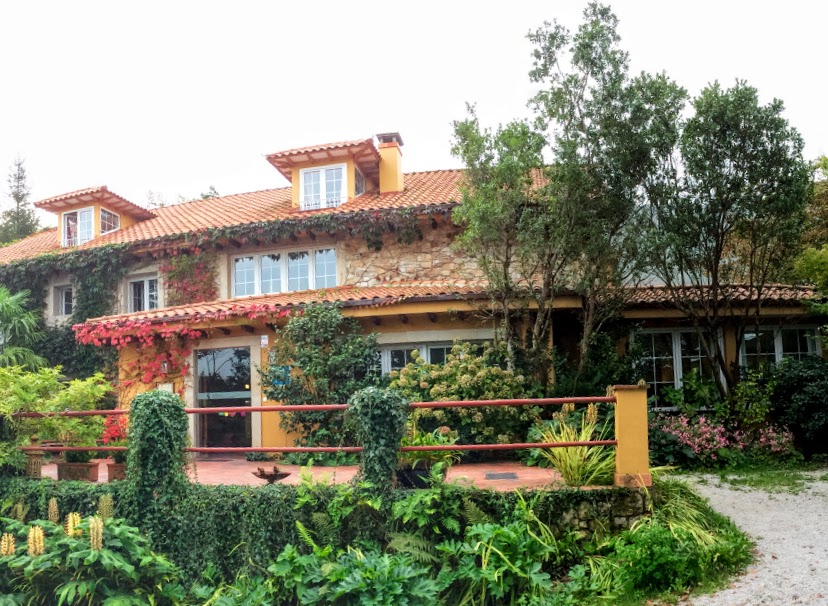
We arrived at El Habana near Llanes after a six hour drive and celebrated with a wonderful arrival meal. El Habana happens to have a great restaurant and we were so done with driving. We're actually not in the town of Llanes, but on the opposite side of the freeway and in the country. We really lucked out on this choice. At night all we can hear is the wind in the trees and the bells on the stock in distant pastures. Here, cows, sheep, goats, and even horses have bells on them. In the countryside, you can always hear bells, it's the music of this part of the world.

On that tranquil note, I'll end this early. Tomorrow is a big hike day and rest is in order. Com'on back for the tale of the Picos De Europa National Park.

Blessings,

Earl and Gwen